“When a woman with an intellectual disability becomes a leader, she opens a door for many other women.” — Maribel Cáceres
Women are already active in the self-advocacy movement.
But when we look at who speaks on the big, visible stages, who represents organisations, and who holds leadership positions, we often see more men than women.
Five women leading by example
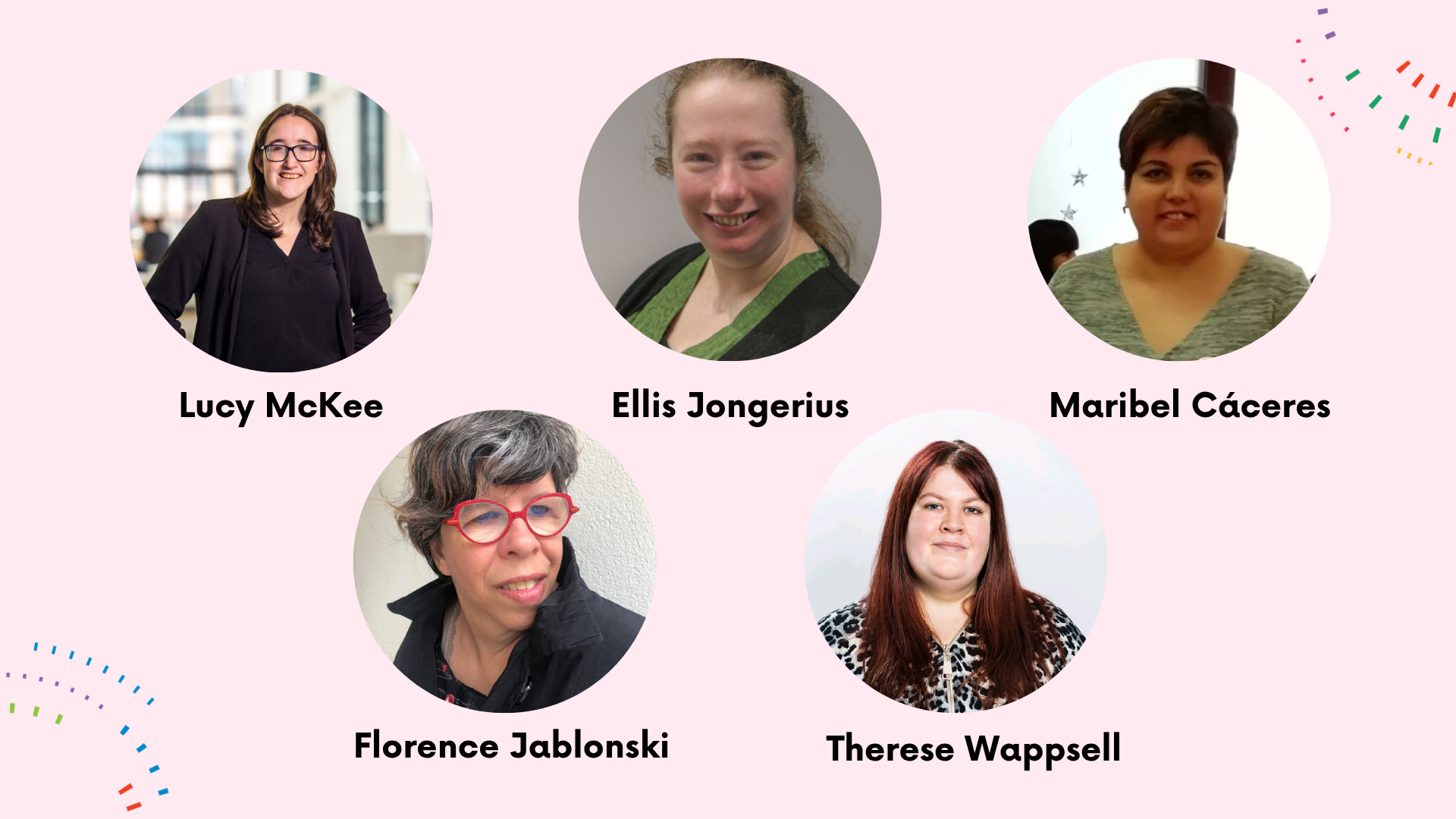
At our Hear Our Voices! self-advocacy meeting this week, we heard from five women who are already leading in their organisations and countries:
Florence Jablonski is president of Nous Aussi in France and a local councillor.
Ellis Jongerius is a director at LFB in the Netherlands. She has a paid job and takes part in decisions about policy, finances and the work of the organisation.
Lucy McKee is a self-advocate and Membership Ambassador with Enable, Scotland. She is also co-chair of its National Self-Advocacy Forum and speaks about rights, health and participation.
Therese Wappsell works as an information officer at FUB in Sweden. She takes part in board meetings, advocacy and work with public authorities and politicians. She also supports local self-advocacy groups.
Maribel Cáceres is vice-president of Plena inclusión España. She takes part in meetings and decision-making spaces and represents the voices of people with intellectual and developmental disabilities.
Their journeys are different. But they show other women what is possible. Seeing another woman speaking, deciding and leading can make someone else think: Maybe I can do that too.
What women self-advocates told us they need
This is what the event speakers and participants told us during the event:
Give women opportunities. Do not always invite the same people to speak. Look for women. Invite them. Give them the floor.
Create ways to leadership. Nobody is born knowing how to lead. Women need opportunities to learn, practise, make mistakes and grow.
Provide the right support. Support should help a woman express her own ideas. It should come from someone she trusts and chooses.
Make women leaders visible. Seeing another woman leading can change what someone believes is possible for herself.
Give women real power. Not only a place in the room. A place where decisions are made. And when the work is a job, pay women for it.
It’s on us to open the door
We should not wait for women to somehow “become ready” for the position of power in organisations. It is our job to open doors, remove barriers and create opportunities.
Women with intellectual disabilities do not only need to be heard. They need the power to decide, represent and lead.
Read also: Gender (in)equality of women and girls with intellectual disabilities in Europe
The event took place online on 22 September 2026. Over 60 participants attended. The event’s organisation was co-funded by the European Union’s CERV program.