Inge Volleberg writes about a conference she spoke at recently.
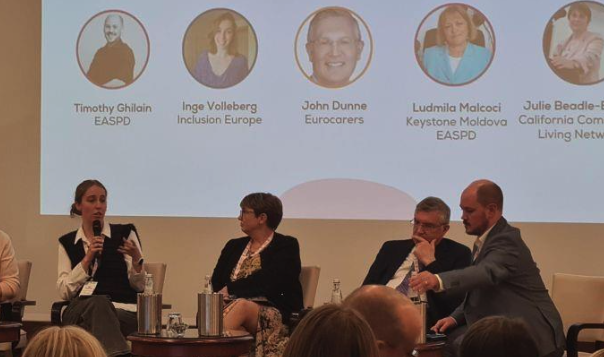
I had the opportunity to represent Inclusion Europe at EASPD’s conference about support for families and about self-determination of people with disabilities. I would like to share the main points I said:
Self-determination
The main policy change that needs to happen now is deinstitutionalisation, especially when you look at enabling self-determination.
Self-determination is about having your own opinions, being able to voice those, and then making your own decisions.
These are skills that people lose (or never learn) in institutions where many, if not all, decisions are made for them.
Being able to live in the community allows people to practice these skills, and this is the strongest tool to enable self-determination.
Families need more support
The majority (if not all) support goes to the person with a disability, which seems about right.
But parents don’t know what they should do; this is a new situation for them too, and they are struggling. The same goes for siblings who often grow up with signs of neglect even though they grow up in a loving home.
The family members need support, because if they are doing well, this benefits everyone in the family.
This also gives family members the space to breathe to then be more active in policy making, etc.
People with complex support needs
People with complex support needs should not be forgotten or left as the last to live in institutions. Everyone benefits from living in the community, and everyone has the chance to thrive when given the chance.
For people with complex support needs, this means individualised care, one on one, round the clock support, and most importantly, building a relationship with the people supporting them.
This takes time, and should involve family members, as they often know their loved one best.
Participation
Lastly, we spoke about collaboration between service providers, families, and people with disabilities. I said that it was sad that there were so few people with (intellectual) disabilities at the conference, while one of the main themes is self-determination.
I spoke with a few self-advocates, and they shared that the conference wasn’t very accessible. I think that if we want better collaboration, we need to make sure that people with disabilities can be and are part of the conversations, from the start.
This means accessible events, inviting people with disabilities, having them part of the organising, and using inclusive langauge.