More than 90 people filled the Teatro Municipal in Lousã, Portugal, on 23 October 2026. Most of them were self-advocates, and they were ready to speak up.
ARCIL organised the meeting, called “Self-advocacy – Forbidden fruit”. They invited me to talk about “the Things we all should know about self-advocacy but nobody told us”.
The date was a happy coincidence. On 23 October 2009, the UN Convention on the Rights of Persons with Disabilities entered into force in Portugal. Seventeen years later, most people in the room did not know the Convention. What does that tell us about claiming the rights we are entitled to?
Why a “forbidden fruit”?
Nobody says self-advocacy is forbidden. There is no rule on the wall. But others decide the timetable, the activities, the menu, who goes on the trip and who goes to the meeting. They make these decisions “in the person’s best interest”, often out of love. The result is the same: the person learns that deciding is not for them.
In Portugal, full guardianship ended only in 2018, when Law 49/2018 created the regime of the “accompanied adult”. But a law can change faster than habits.
So why is this fruit still not wanted? Some reasons stand out:
- You cannot want what you have never tasted. If you have never been asked, you stop expecting to be asked.
- Saying no has a cost. When you depend on others for transport, money or daily support, it is easier to say yes.
- You cannot claim rights nobody told you about.
- For services and families, it is not on the agenda. Self-advocacy is seen as an extra activity, not as the way support should work every day. It asks them to share power, accept risk and live with mistakes.
So self-advocacy is often not forbidden. It is simply not on the table.
What the raised hands showed
The morning workshop was called “Everything I needed to know about self-advocacy and nobody told me”. It was interactive, even in a theatre with fixed seats. People answered with their hands, with coloured cards, or in whatever way worked for them.
“Raise your hand if today you…” decided when to get up, chose who you came with, know how much money is in your pocket, chose to come to this meeting, or have said “no” to a professional or a family member and were listened to.
Many hands went up for the everyday choices. That included knowing how much money is in your pocket, which probably would not have happened five years ago. But pocket money is not real control over your finances.
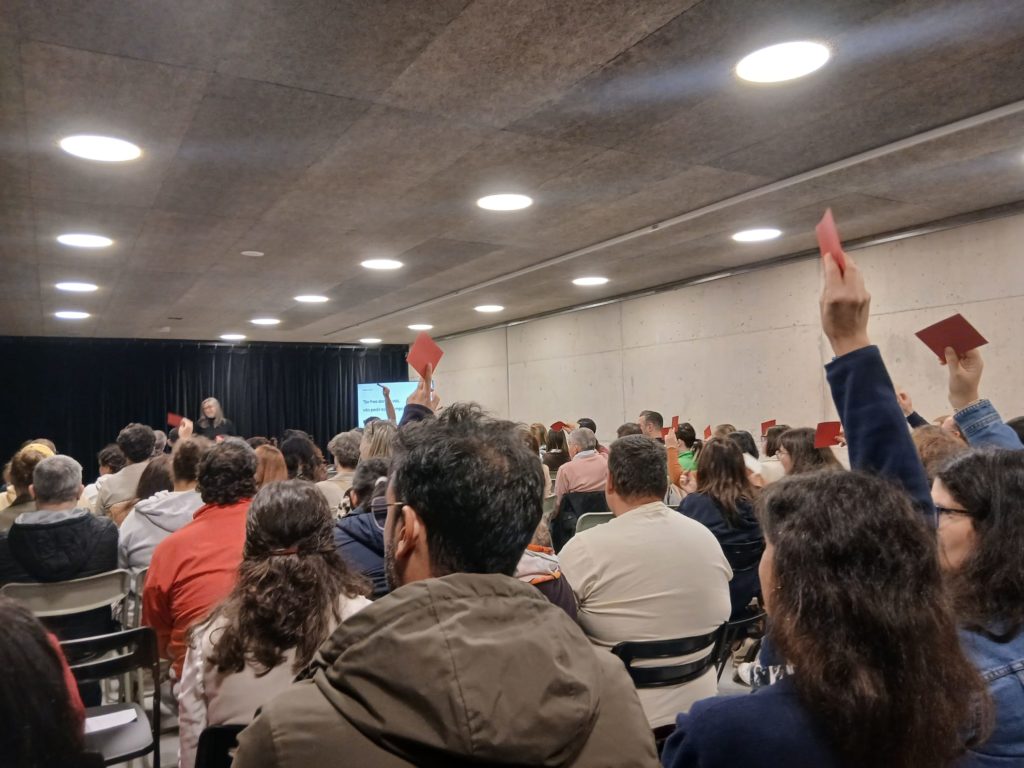
Some hands stayed down when I asked who had chosen to come to the meeting. For the last question, most hands stayed down. Saying “no” and being heard is still not part of everyday life.
The self-advocates named the problem themselves. They spoke without fear. They talked about overprotection. They also claimed two rights loud and clear: the right to make mistakes, and the right to say no. Nobody needed a slide to explain this.
Self-advocacy does not start in a meeting. It starts with small choices every day, with the right to get things wrong, and with a “no” that is respected.
On the stage
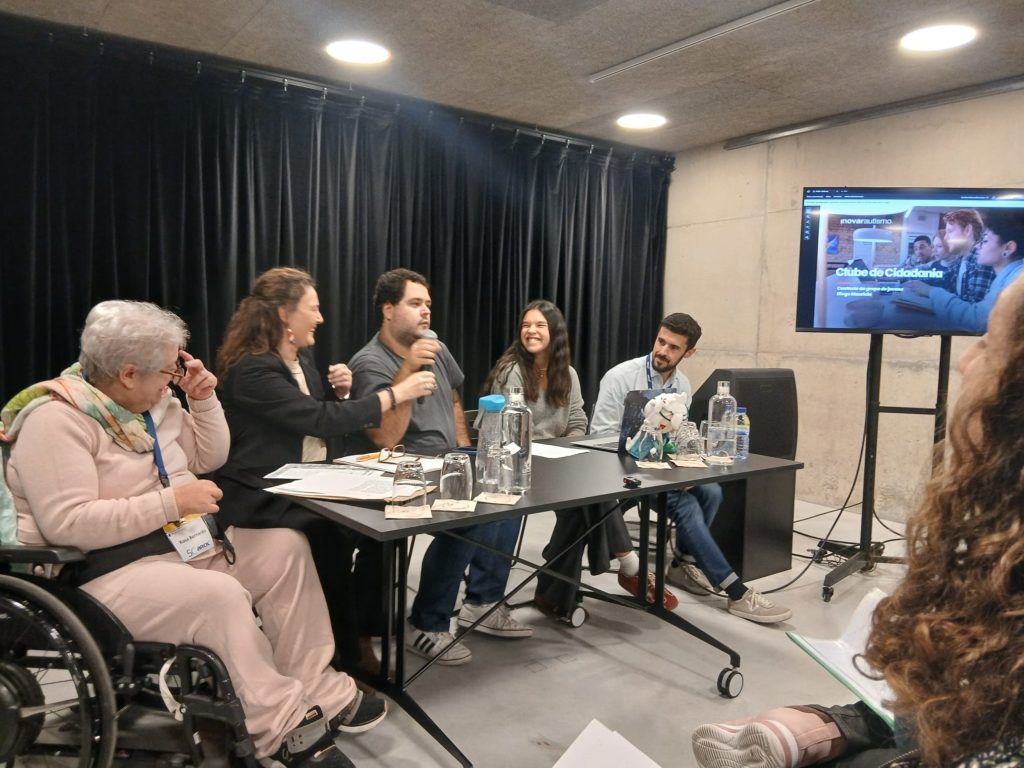
In Lousã, self-advocates also presented and moderated the sessions. When a self-advocate holds the microphone, the message changes, because others see someone like them as an expert. Moderating is power, too: it means deciding the questions, the time and the turns. Too often, self-advocates are invited to answer but not to lead. Here it was the other way round, and that should be the rule.
This needs easy-to-read information, time to prepare together, and a support person who helps without taking over. It is not extra work. It is part of making a meeting truly inclusive.
The hidden “bits”
Being in the room is not the same as being free to take part. Most self-advocates came with the organisations that support them. That made their presence possible, but it raises a question: who decides who goes and who stays at home? Many participants also had to leave at a set time because they had no transport of their own. They missed the end of a conversation or the afternoon session. These limits look practical, but they decide who speaks, for how long, and about what.
Beyond “us” and “the others”
“Nothing about us without us” has been the motto of the disability movement for decades. But there is nothing about persons with disabilities that is not also about everyone else. The bus, the health centre, the school, the town budget and the local festival are decisions about all of us, together.
The UN Committee on the Rights of Persons with Disabilities says the same in its General Comment on participation of people with disabilities. Persons with disabilities must be involved in all decisions that affect them, directly or indirectly, including general laws and public budgets.
The self-advocates in Lousã showed they want to be part of these decisions.
Sandra Marques, self-advocacy coordinator