The European Parliament adopted its position on the next EU budget. This is an important step because it gives strong recommendations to the European Commission, which will design the next EU budget.
Right now, the European Union is discussing its next long-term budget. This is the money that will be spent over several years across the EU.
We believe EU money should:
- Be invested in people. That means supporting their education, skills, jobs, and participation in the community.
- Follow clear rules to support rights and inclusion. EU funding should be rights-based, easy to use, effective, and involve people with intellectual disabilities and their families in decisions.
- Help end segregation and isolation. EU money must support inclusion in all aspects of life.
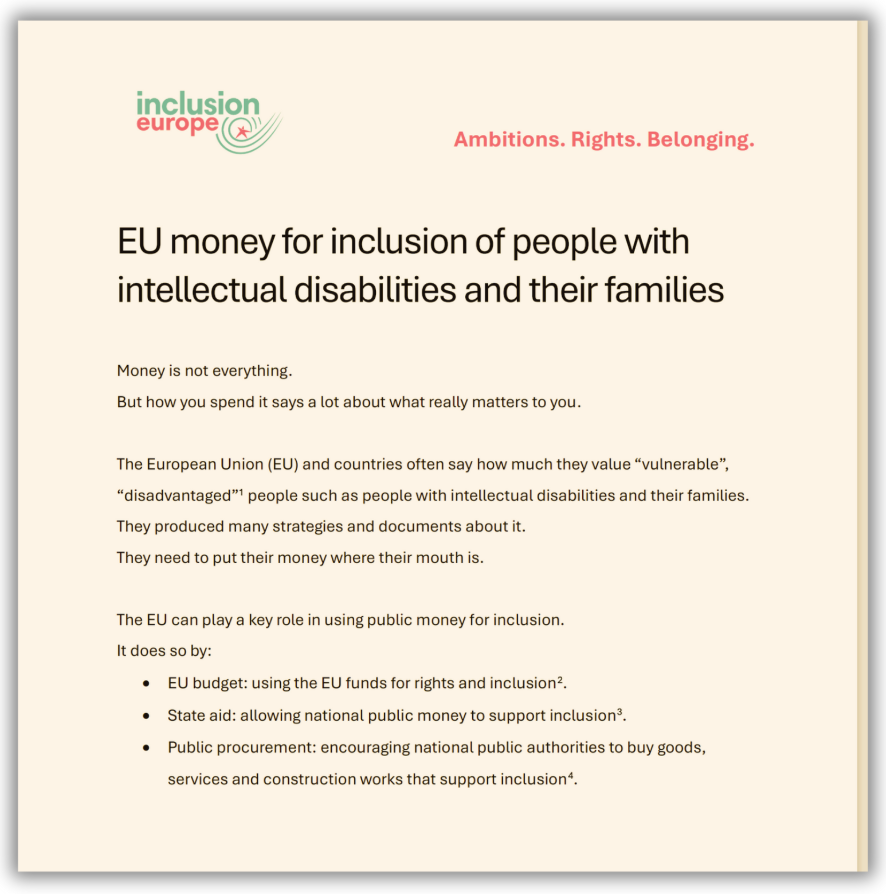
Recently, the European Parliament adopted its position on the next EU budget. This is an important step because it gives strong recommendations to the European Commission, which will design the next EU budget.
This position matters for people with intellectual disabilities because it supports key areas of their inclusion.
What does the European Parliament want?
To include social inclusion in the EU framework for competitiveness.
The European Parliament says inclusive economy is a must to ensure competitivity. It helps people to have good jobs and good standard of living.
To fight inequality and social exclusion.
The EU budget should support the European Pillar of Social Rights and its Action Plan.
One of the important topics of this general social policy is the inclusion of people with disabilities.
Even though it is not explicitly mentioned in the report, this means the EU budget should help inclusion of people with disabilities.
To protect fundamental rights.
EU money should only go to countries that respect rights – including the rights of people with disabilities under the UN Convention on the Rights of Persons with Disabilities (UNCRPD).
This condition is known as a “horizontal enabling condition” and its purpose is to prevent EU money from being used for segregation of people with disabilities.
To make EU funds easier to access.
The budget should be simpler to use, but still support high-quality actions.
To focus on results.
EU money should be judged on what it achieves. There should be performance indicators to make sure goals like deinstitutionalisation are being met.
No mention of people with disabilities
The European Parliament’s report is mostly a step in the right direction. It gives a strong message about the importance of investing in social inclusion.
But we regret that the text does not mention people with disabilities. Mentioning people with disabilities would send a clear message that they matter and that EU money must be used to support their rights.
What should happen next?
The European Commission will present its proposal for the EU budget. Then, it will be discussed and approved between the European Commission, the European Parliament, and EU countries (represented by the Council).
Inclusion Europe will keep advocating for the budget to prioritise people with intellectual disabilities and their families.
Our members and other organisations advocating for full rights and inclusion should bring this message to their governments and members of parliament too.