“We meet because we have the right to say our opinions.”
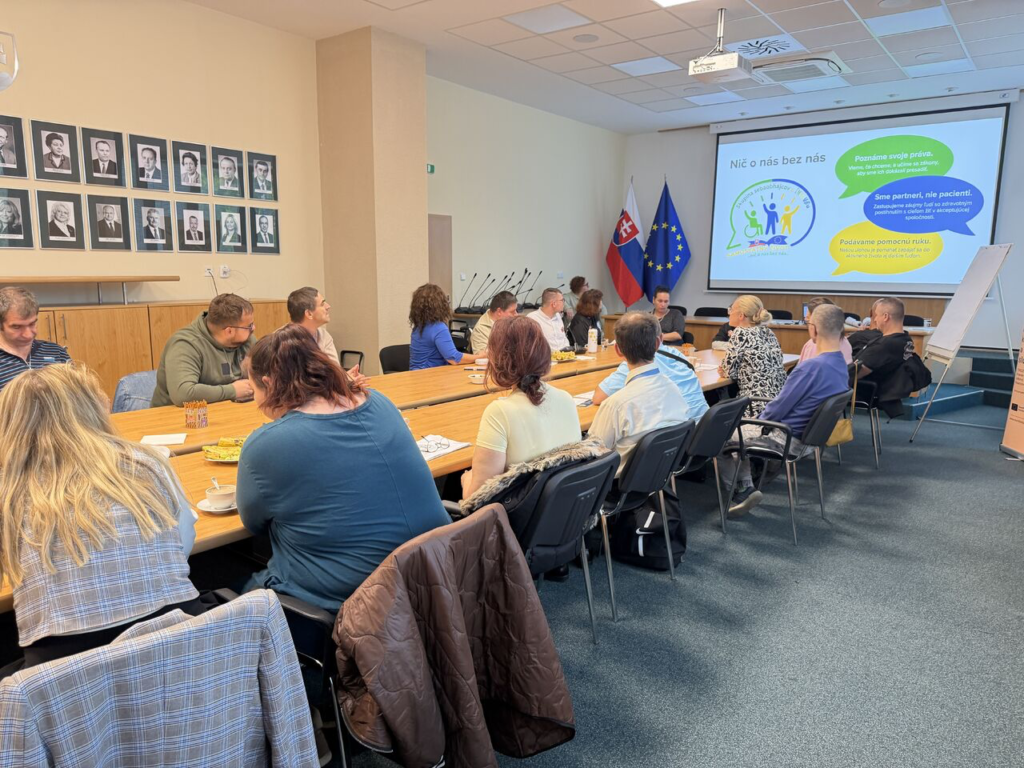
That’s how one self-advocate explained what they are doing. It was during a self-advocates’ meeting in Bratislava, Slovakia 🇸🇰 on 14 October.
It says almost everything about why self-advocacy matters.
I spent two days in Slovakia. Two days full of connections and stories.
Eight towns, one shared goal
The first day I spent listening to self-advocacy groups from all over Slovakia. The meeting was organised by the Council for Counselling in Social Work (Rada pre poradenstvo v sociálnej práci), as part of a project of the Slovak Ministry of Social Affairs.
Every group is different. And every one of them is busy.
Some have been meeting candidates ahead of the local elections, making sure the people who want to run their towns know what life is like for people with intellectual disabilities. Others are pushing for housing and for jobs where they live. Several are fighting for personal assistance, which is still too often refused to people with intellectual disabilities, as if it were only meant for other people. And some are working to make public buildings in their towns accessible, one building at a time.
There’s also a group of parents, working for early support for young children and for schools where children with and without disabilities learn together.
Different places, different people. But everyone in that room shared the same wish: to make Slovakia a better place for people with disabilities. Starting with coming together to say what their lives are like, and expecting to be heard.
I talked a little about self-advocacy at Inclusion Europe. I learned a lot more than I shared.
From a conference to a new law
The next day, I met with Iveta Mišová and Marián Horanič from ZPMP, our member organisation in Slovakia. We talked about something they have been working on for a very long time, and that has finally happened.
Slovakia has changed its civil code to bring in supported decision-making. In plain terms: instead of someone else making decisions for you, you get the support you need to make your own decisions about your own life. It’s one of the most important changes there is for people with intellectual disabilities, because it is about who is in charge of your life.
The story goes back to 2007, and to our Europe in Action conference in Warsaw. Supported decision-making was the main topic that year. The ideas and examples people shared there stayed with many of those who attended, and inspired years of work in their own countries afterwards.
“Sixteen years ago we started the work with an analysis and arguments about what needs to change,” they told me. “Others played a big part over the years. Now it’s finally done.”
Slovakia isn’t the only country where this has happened, and it took quite a while. But it’s here now.
That wasn’t all we talked about. ZPMP runs a social business that employs people with intellectual disabilities, and trains people for jobs.
They also organise an annual national meeting of self-advocates, and we talked about why that kind of visibility matters so much: when people with intellectual disabilities are seen and heard in public, it gets harder for anyone to make decisions about them without them.
Thank you to everyone in Bratislava, for the conversations, the honesty, and all your work.
Together for full rights and inclusion.
Milan Šveřepa, Chief Executive, Inclusion Europe