Guide to deinstitutionalisation for people with intellectual disabilities
This is what you do (PDF)
Living in your own place.
Having friends.
Making your own choices.
Being good at something.
Belonging.
That is what it means to live independently and be included.
For many people, this is just part of everyday life.
They do not think much about it.
But for a lot of people with intellectual disabilities, this is not the case.
A lot of people with intellectual disabilities live isolated in “care” institutions.
What’s wrong with “care” institutions?
Close to 1 million people with intellectual disabilities in Europe are segregated in “care” institutions. Most at risk of this segregation are people with complex support needs.
“Care” institutions are residential buildings and services which:
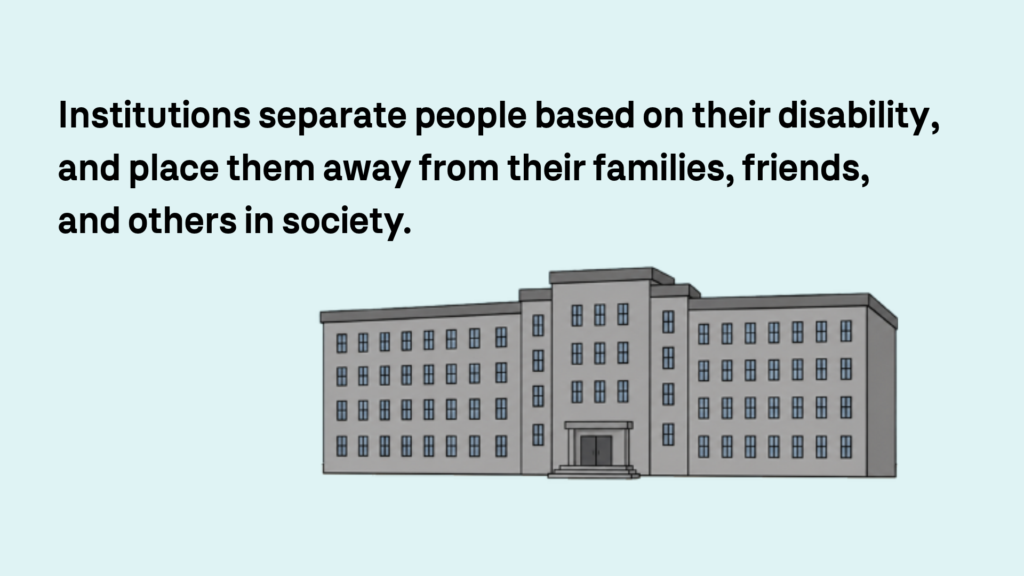
- Separate people in groups, based on their disability.
- Place them far away from their families, friends, and others in society.
- Rule over the person’s life with the institution’s procedures and rules.
- Remove all the daily stuff people would usually do and replace it with group activities called “therapies”, “activisation” or “outings”.
- Deny people the opportunity to experience life, gain social skills,
build relationships, and grow with age. All in the name of “protection”.
Placing people in institutions and subjecting them to these harms is called institutionalisation. Institutionalisation is very harmful to people. It denies them their place in this world, and it denies them their rights.
Despite what institutions like to say, they are not safe places that protect people. Institutionalisation causes psychological harm and puts people at risk of neglect and abuse.
Institutions do not affect only the people living there. They also impact their families and friends. When someone lives in an institution, their relationships with people outside are often restricted or lost over time.
Institutions are also a threat to those people with intellectual disabilities who are not institutionalised. Yet.
Many people with intellectual disabilities depend heavily on their families, because there is no support to live independently. The public money has already been spent on institutions. As a result, parents, siblings, and other relatives may spend years providing support and advocating for their family member.
And for a lot of people with intellectual disabilities, institutionalisation is what awaits them when their families can no longer provide the support they need.
As long as institutions exist:
- They continue to harm people and prevent them from living independently and being included in the community.
- They consume a lot of money that should instead be used to provide support in the community.
For these reasons, institutionalisation is a key issue for the disability rights movement, including people with intellectual disabilities and their families.
The segregation of people with intellectual disabilities and isolation of their families must end.
“Care” institutions must be closed and replaced with support in the community.
What is deinstitutionalisation?
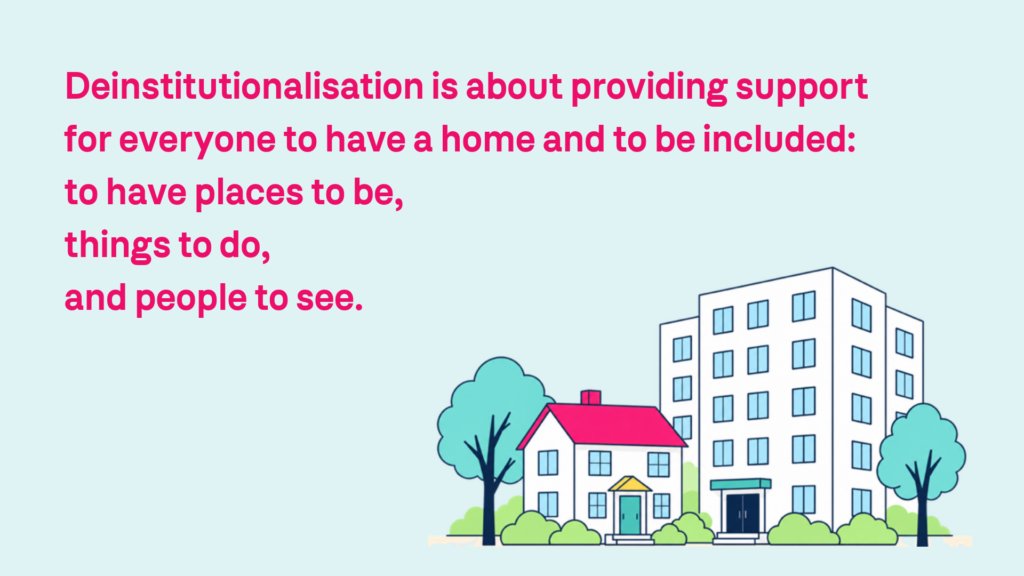
Closing “care” institutions, preventing new ones from being built, and supporting people to live independently and be included in the community is called deinstitutionalisation.
To live independently and be included in the community means:
- Making your own choices about where and with whom to live.
- Living your daily life as you want.
- Having the support you need.
- Being able to use public services like everyone else.
- Having people you can rely on, like family, friends, or others.
- Taking part in and contributing to community life.
Everyone can live independently. Some people need more support than others in that.
Why did we write this guide?
Inclusion Europe wrote this guide (PDF) because a lot of people with intellectual disabilities are still segregated in “care” institutions.
At the same time, there is a lot of work being done in the name of deinstitutionalisation. And a lot of confusion about what it means.
Sometimes, governments and service providers say they are doing deinstitutionalisation, but in reality, they are not.
- Moving people into smaller institutions, or into “modern” buildings that still separate them from the community, is not deinstitutionalisation.
- Leaving people without support is not deinstitutionalisation.
Policymakers, public authorities and service providers often say that it is not clear how to do deinstitutionalisation, or that it is too complicated. This is incorrect.
- Deinstitutionalisation is not a rocket science. It has been done in many places before. We know it is possible.
- Countries have already closed many institutions and replaced them with support in the community. Some countries are working on it right now.
This guide is mainly for policymakers, public authorities, and service providers responsible for planning, funding, or delivering deinstitutionalisation.
It can also be useful for people with intellectual disabilities and their families who want to understand what deinstitutionalisation is.
This guide is based on the knowledge we have gained over many years, participating in deinstitutionalisation work and talking with many people involved in it (from people with intellectual disabilities, through service providers, to policy-makers).
It gives recommendations about how to do deinstitutionalisation, and it provides a framework to evaluate whether the process has led to independent living and inclusion for individual people.
Read this guide, and start doing the work to make independent living in the community a reality for all people with intellectual disabilities.