Jeanne Nicklas-Faust became President of Inclusion Europe at our General Assembly on 26 May.
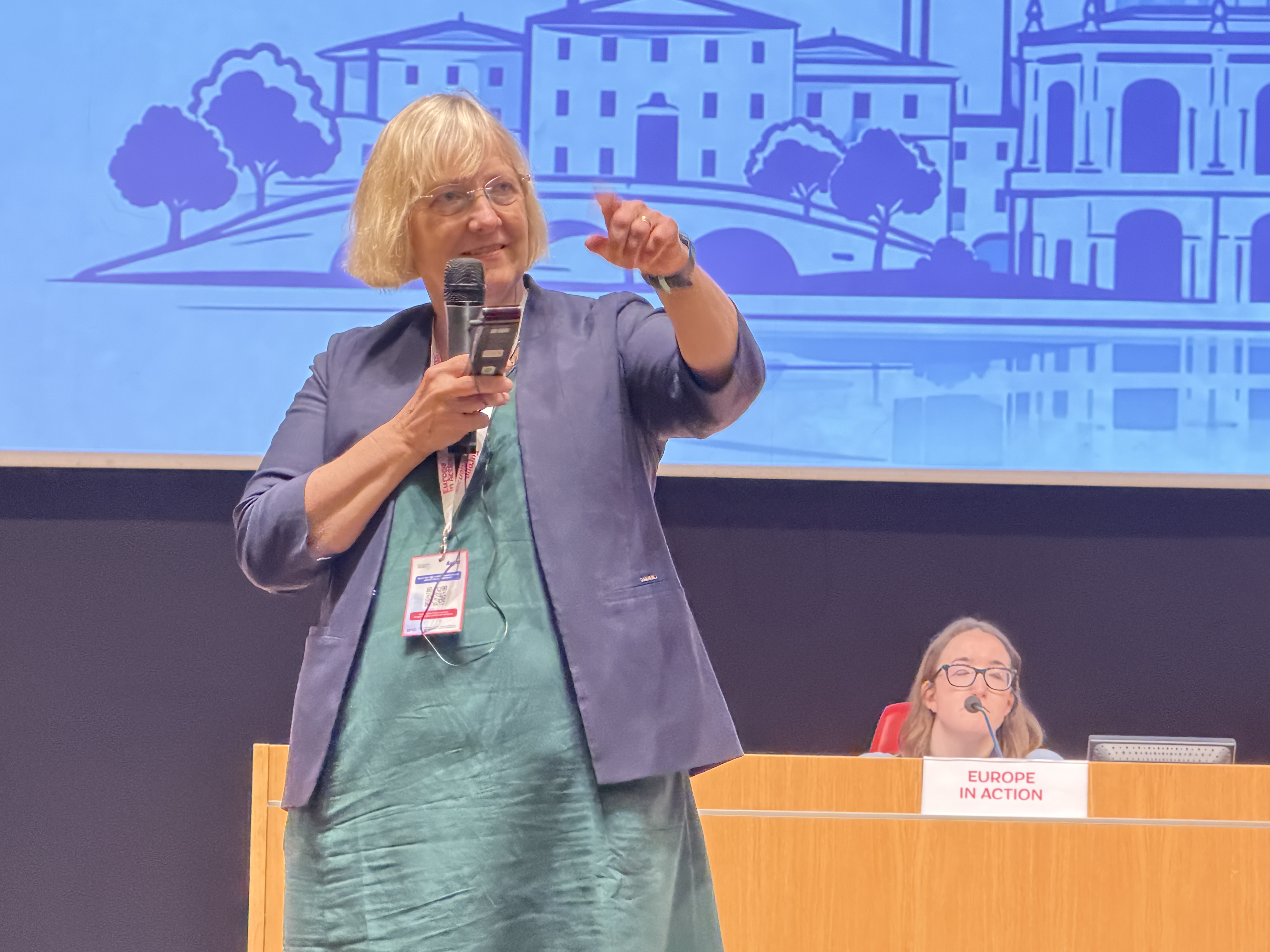
The next day, Jeanne spoke at the closing session of the Europe in Action conference in Vicenza.
This is what Jeanne said:
Dear colleagues, dear friends.
It is an honor and a pleasure to speak to you today at this important conference of Anffas and Inclusion Europe. Together, as members of Inclusion Europe, we form a strong European movement of and for families of people with intellectual disabilities — a movement that makes a real difference.
I am speaking to you as the new President of Inclusion Europe, and I am still deeply moved and humbled by this responsibility.
Progress achieved
When we look back over the past ten or twenty years, we can clearly see how much has changed. There has been real progress for people with intellectual disabilities. This progress is visible not only within our organizations, but also in the way people with disabilities engage with the wider world.
More and more, people with intellectual disabilities are speaking for themselves. They are no longer only represented by others — they are becoming strong and visible self-advocates across Europe. We see them more often in public debates, in dialogue with policymakers, and as active participants in shaping our organizations. And, crucially, we see more and more people living self-determined lives and making their own decisions.
This is a powerful and positive development. It is a major achievement of our joint work and commitment — and it brings with it an ongoing responsibility for us as organizations.
Our responsibilities
We must continue working towards a future in which people with disabilities, together with their parents and siblings, take an even stronger role in guiding our organizations. This is about shared leadership, mutual respect, and true partnership.
This is a task for all of us — as individuals and as organizations. Paths are made by walking, so let us continue to explore new ways to strengthen self-advocacy and shared leadership.
This principle also applies to our work at board level. It guides the way we collaborate — including my own role as a mother and working together with László Bercse in his role as Chair of EPSA.
Developing how we work together
I intend to build on what has already been started and to further develop our collaboration towards genuine shared leadership. The success of strong self-advocacy shows what is possible when different perspectives come together with a shared purpose.
At the same time, if we want to grow and evolve as a movement, we must strengthen how we work together.
We need to be more united, more coordinated, and more collaborative. This means strengthening cooperation among our members, deepening connections between them, and reinforcing their role within our shared organization.
And for this collaboration to truly succeed, we must ensure that there is space for every member of the family.
People with disabilities, their parents, and their siblings all need room to express their needs, to connect with others, and to receive the support they need. Only when everyone has the opportunity to make their voice heard can we truly be an organization for all.
Even though we walk the same path, we bring different perspectives, needs, and interests. This is not a weakness — it is our strength.
If we create enough space for these differences, we can bring them together and become stronger in our shared action. We are here for the whole family — and for each and every family member.
This is both a collective responsibility and a great opportunity.
Housing
Another area where we have seen major progress over the past decades is housing.
Not long ago, most people with disabilities lived in large institutions. Over the past twenty years, however, a wide range of new living arrangements has emerged. Today, more people are living in their own homes, with partners, or in small, shared homes within their communities. These developments have made it possible for many to live more independent and self-determined lives.
However, we must also be honest: This progress is under pressure.
In recent years, we have seen worrying trends across Europe. There are voices calling for a return to institutional models, often based on arguments about lower costs. We cannot accept this.
We must stand firm and resolute in defending the rights of people with disabilities — especially the right to live independently and to be included in the community.
Threats to support people rely on
This challenge is becoming even more urgent in light of broader developments. Across Europe, austerity measures and cuts in social services are threatening the support systems people rely on.
This makes strong political advocacy more important than ever.
We must build on the foundations we have laid in recent years: Our close relationships with the European Commission, with members of the European Parliament, and with other European organizations. These connections are essential if we want to defend rights effectively and ensure that our voices are heard.
At the same time, we must continue strengthening our internal cooperation — becoming more united, more strategic, and more effective together.
We won’t step back
This is a shared task — and a great opportunity.
I very much look forward to working with all of you:
- to bringing in our perspectives,
- to using our resources wisely,
- and to shaping the future together.
Because in the end, it is clear:
We have come a long way — but we are not finished.
We will not step back.
We will not give up what has been achieved.
And we will not stop until every person with an intellectual disability can live a self-determined life, fully included in their community.
And families get the support they need and the respect for their life – since it is normal to be different!
Together, we are strong.
Together, we are heard.
And together, we will move forward.
Thank you very much.
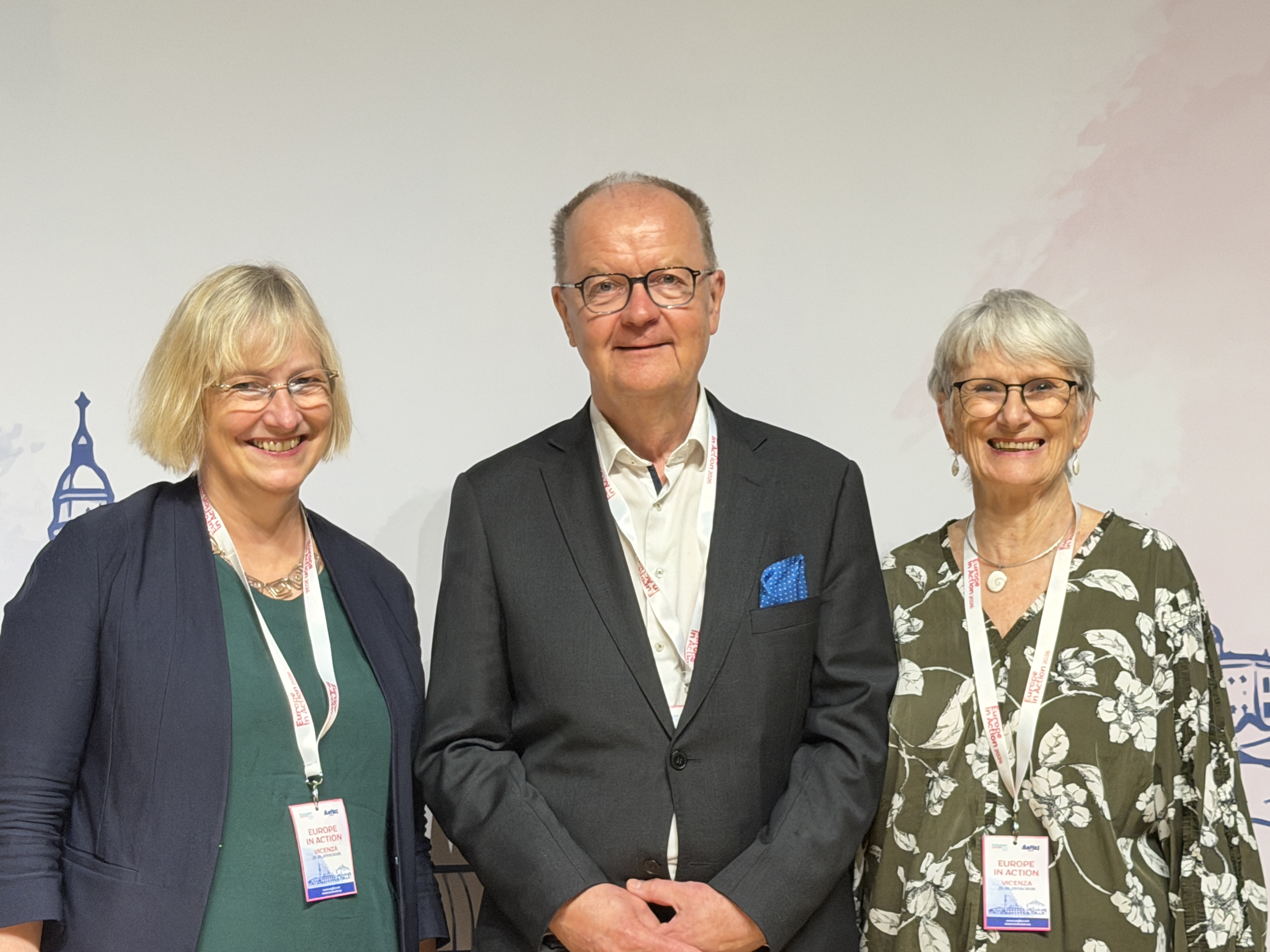
- Current President and two Past-presidents of Inclusion Europe. Jeanne Nicklas-Faust with Jyrki Pinomaa and Maureen Piggot at Europ in Action 2026.